• NASA Portal
  • Site Help
  • Feedback
  • Phone Book
Search For:
in
  • HOME
  • OVERVIEW
  • DATA
  • ANNEX
  • DOCUMENTS
  • SOFTWARE
  • PERSONNEL
  • RELATED SITES
  • ABOUT PDS
 
  • Instrument
  • Missions
  • Target/Planet
  • Volume Series
  • Errata

Pioneer Venus

TARGETS

QUICK LINKS

FAQ
Citation Policy
Errata for all volumes
Help for Data Users
Help for Data Reviewers
Help for Data Providers

PDS NODES

PDS Home
Atmospheres
Geosciences
Cartography and Imaging Sciences
NAIF (SPICE)
Ring-Moon Systems
Small Bodies
Management
Pioneer Venus Archive Page
Pioneer Venus

START DATE : 1978-05-20 ~ STOP DATE : 1992-10-07


Mission Overview
================

[From COLIN1980B]
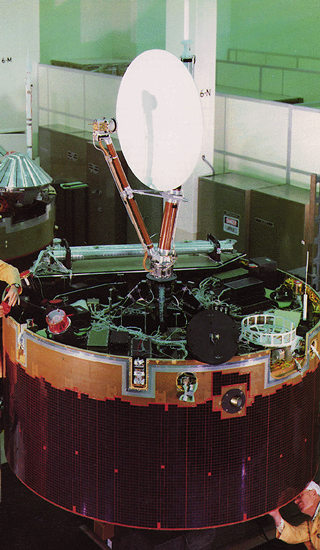
Pioneer Venus consists of two basic spacecraft: Orbiter and Multiprobe [1]. The latter was separated into five separate vehicles near Venus. These were the probe transporter (called the Bus), a large atmospheric entry probe (dubbed Sounder) and three identical smaller probes (called North, Day, and Night in accordance with their entry locations). At Venus all six spacecraft communicated directly back to the Earth-based Deep Space Network (DSN) and, in the case of the Multiprobe mission,to two special receiving sites near Guam and Santiago (Chile).

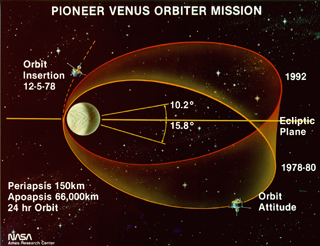
The Orbiter was launched on May 20, 1978, encountered Venus on December 4, 1978, was inserted into orbit on that same day after a Type II interplanetary cruise trajectory lasting 198 days and covering more than 500 x 10^6 km. Twelve scientific experiments were included in the instrumentation payload and a few radioscience investigations were planned using the S-band telemetry signal carrier and a special X-band beacon included as part of the spacecraft hardware. Scientific observations were made both in-cruise and in-orbit. The nominal in-orbitmission was designed to extend for one Venus year (243 days).
more ...

×

Pioneer Venus


Mission Overview
================

[From COLIN1980B]
Pioneer Venus consists of two basic spacecraft: Orbiter and Multiprobe [1]. The latter was separated into five separate vehicles near Venus. These were the probe transporter (called the Bus), a large atmospheric entry probe (dubbed Sounder) and three identical smaller probes (called North, Day, and Night in accordance with their entry locations). At Venus all six spacecraft communicated directly back to the Earth-based Deep Space Network (DSN) and, in the case of the Multiprobe mission,to two special receiving sites near Guam and Santiago (Chile).

The Orbiter was launched on May 20, 1978, encountered Venus on December 4, 1978, was inserted into orbit on that same day after a Type II interplanetary cruise trajectory lasting 198 days and covering more than 500 x 10^6 km. Twelve scientific experiments were included in the instrumentation payload and a few radioscience investigations were planned using the S-band telemetry signal carrier and a special X-band beacon included as part of the spacecraft hardware. Scientific observations were made both in-cruise and in-orbit. The nominal in-orbitmission was designed to extend for one Venus year (243 days).

During the nominal mission all but two experiments operated 100 percent successfully. One, the Radar Mapper, produced unusable data for a 32-day period from December 18, 1978 to January 19, 1979. The data lost [were to] be acquired during the extended Orbiter mission. The other, the Infrared Radiometer, failed to operate after February 14, 1979, but had collected an enormousquantity of valuable information prior to that date.

The Multiprobe was launched on August 8, 1978, encountered Venus on December 9, 1978 (just five days following the Orbiter insertion) after a Type I interplanetary cruise trajectory lasting 123 days and covering 330 x 10^6 km. The Sounder was released from the Bus on November 15, 1978, and the three small probes were released simultaneously on November 19, 1978. All probes entered (200-km altitude) the Venus upper atmosphere within a time span of about 11 min and descended to the surface in a period from 53 to 56 min, all the time performing scientific observations. The Bus made a delayed (~90 min) entry relative to the probes into Venus' upper atmosphere and burned up at about 110-km altitude since it was not protected, as were the probes, with entry heat shields. Scientific observations were made during the one-minute interval from 700 to 110 km. Although not designed for `survival' after impact, the Day probe managed to transmit for over 67 min on the surface (it in fact continued to transmit after the Bus transmission ceased). Seven scientific experiments were included in the Sounder instrumentation payload, threeidentical experiments in each small probe, and two in the Bus.
Again, radioscience experiments were performed using, separately or together, the S-band telemetry signal carriers emanating from the spacecraft and received at the Earth-based tracking stations. In general, all instruments performed nominally, although certain instruments behaved anomalously onall four probes near the surface.

References:
[1] L. Colin and C.F. Hall, Space Sci. Rev., vol. 20,no. 3, p. 283, May 1977.

Mission Phases
==============

PIONEER VENUS ORBITER VENUS ORBITAL OPERATIONS
----------------------------------------------
This mission phase 'orbiter operations' describes the entiremission of the Orbiter spacecraft.

Spacecraft Id : PVO Target Name : VENUS Mission Phase Start Time : 1978-12-05 Mission Phase Stop Time : 1992-10-02 Spacecraft Operations Type : ORBITER OPERATIONS

PIONEER VENUS ORBITER VENUS ENCOUNTER
-------------------------------------
This mission phase 'encounter' describes all operations of the 5 separate probe components of the Multiprobe componentof the Pioneer Venus mission.

Spacecraft Id : PVMP Target Name : VENUS Mission Phase Start Time : 1978-12-07 Mission Phase Stop Time : 1992-12-07 Spacecraft Operations Type : ATMOSPHERIC PROBE

The Planetary Plasma Interactions (PPI) Node of the Planetary Data System (PDS)


Available Data


External Reference

 
  • Colin, L., Pioneer Venus Overview, IEEE Transactions on Geoscience and Remote Sensing, Vol GE-18, No. 1, pp. 5-10, 1980.
  • Privacy / Copyright
    Freedom of Information Act
    Web Master: PDS-PPI Operator
    NASA Official: Becky McCauley-Rench